How to Embody a Character So Fully That It Feels Effortless
Share this post
How mentally fit are you? Find out in seven minutes.
Take the free quizKey points
- Effortless characters rarely come from trying harder in the moment. They come from a short, repeatable way of stepping into the role before you walk out.
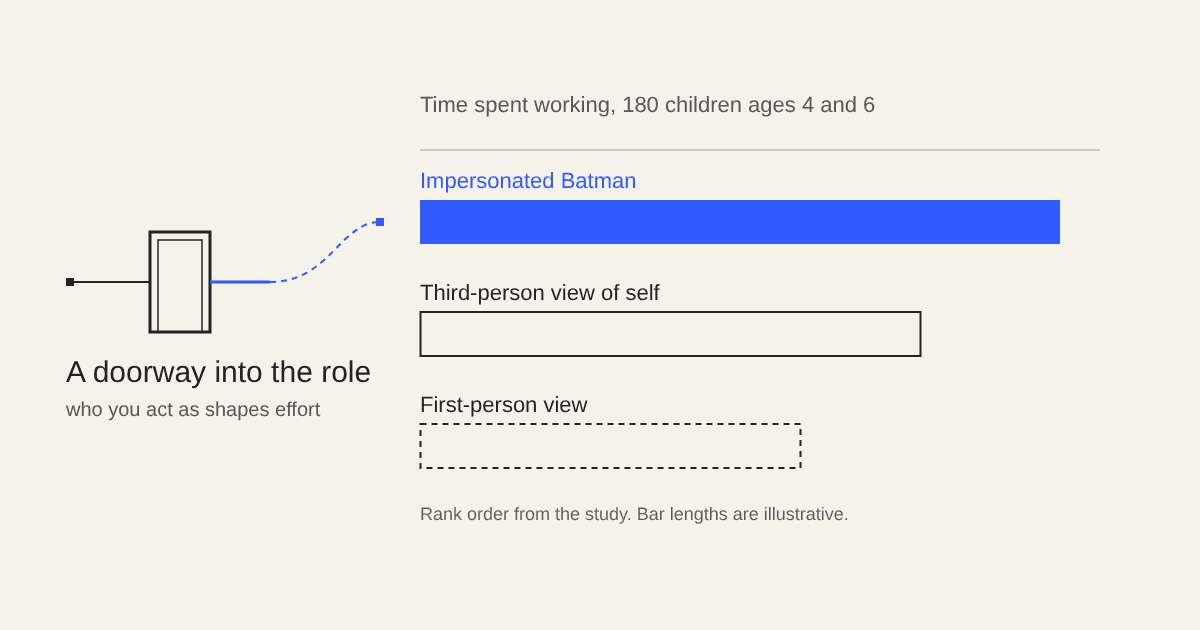
- In a study of 180 four- and six-year-olds, children who impersonated an exemplar such as Batman worked longest on a dull task, ahead of children who took a third-person or first-person view of themselves.
- Another study found that wearing a lab coat described as a doctor's coat increased sustained attention, compared with a coat described as a painter's. The meaning you attach to the costume matters, along with wearing it.
You are in the wings. The role is learned, the lines are in your body, and the house lights are going down. Then a thought shows up: you are about to pretend to be someone else, and everyone will see you doing it.
That thought is the gap between playing a character and being in one. Closing it is a skill, and it can be trained.
Effortless is a state you enter
When a performance looks effortless, it is easy to assume the person simply has it. Look closer and you will usually find a doorway. A walk, a piece of wardrobe, a breath, a first line. Something that tells the body: I am them now.
If you do not have a doorway, you spend the first ten minutes of a scene building the character in front of an audience. If you do, you arrive already inside.
What two studies suggest about stepping in
Researchers led by Rachel White at the University of Minnesota tested what happens when children take on a character. In a study of 180 four- and six-year-olds, each child had to keep doing a repetitive task for ten minutes, with the option to take breaks and play an extremely attractive video game. Some children were asked to impersonate an exemplar, such as Batman. Others looked at themselves from a third-person view, and others took a first-person view.
Across both ages, the children who impersonated the exemplar spent the most time working. The third-person group came next and the first-person group last. These were young children and a dull task, so treat it as a clue about how identity shapes effort. It does not predict how an adult will do in a lead role.
A second line of research looks at costume. Hajo Adam and Adam Galinsky ran experiments on what they call enclothed cognition, using a lab coat. Wearing the coat increased selective attention compared with not wearing one. In later experiments, a coat described as a doctor's coat increased sustained attention compared with the same kind of coat described as a painter's coat. Wearing it and knowing what it stands for both mattered.
Put the two together and you get a useful idea. Who you are acting as, and what the costume means to you, can change how you pay attention and how long you stay with the work. That is something you can set up on purpose.
Three things to try
1. Choose one object that means the character. A ring, a jacket, a pair of shoes. Pick it for what it says about who they are, then wear it only for this role. Each time you put it on, say the character's name in your head. You are teaching your attention what that object means.
2. Walk in as them for thirty seconds before you walk on. Find a hallway or a corner. Take on their posture, their pace, the way they look at a room. Then give them one sentence of intent: what do they want right now? Let that want drive your eyes.
3. Rehearse the first minute in your mind. Close your eyes for two minutes and run the opening as the character. Feel the floor, hear the first cue, see the person you are speaking to. When the real moment comes, your body has already been there once.
The character is already in you. Give them a doorway, and they will walk through it.

Research referenced
- White, R. E., Prager, E. O., Schaefer, C., Kross, E., Duckworth, A. L., & Carlson, S. M. (2017). The "Batman Effect": Improving perseverance in young children. Child Development, 88(5), 1563-1571.
- Adam, H., & Galinsky, A. D. (2012). Enclothed cognition. Journal of Experimental Social Psychology, 48(4), 918-925.
Frequently asked questions
How do actors get into character quickly?
Most use a short, repeatable entry routine that combines a physical cue, such as a costume piece or a way of standing, with a clear idea of who the character is and what they want. The studies cited here suggest that both the physical act and the meaning attached to it can change how you attend and how long you stay with a task.
What is the Batman Effect?
The Batman Effect is the name given to a finding in a 2017 study of 180 four- and six-year-olds. Children who impersonated an exemplar other, such as Batman, spent more time working on a repetitive task than children who took a third-person or first-person perspective on themselves.
What is enclothed cognition?
Enclothed cognition is the influence clothes have on the wearer's psychological processes. In a 2012 paper, Adam and Galinsky reported that it depends on both the symbolic meaning of the clothes and the physical experience of wearing them.