How to Stay Composed in a Tough Board or Investor Meeting
Share this post
How mentally fit are you? Find out in seven minutes.
Take the free quizKey points
- The racing heart and tight chest before a hard meeting are signs your body is mobilizing energy. What you tell yourself about them shapes how you perform.
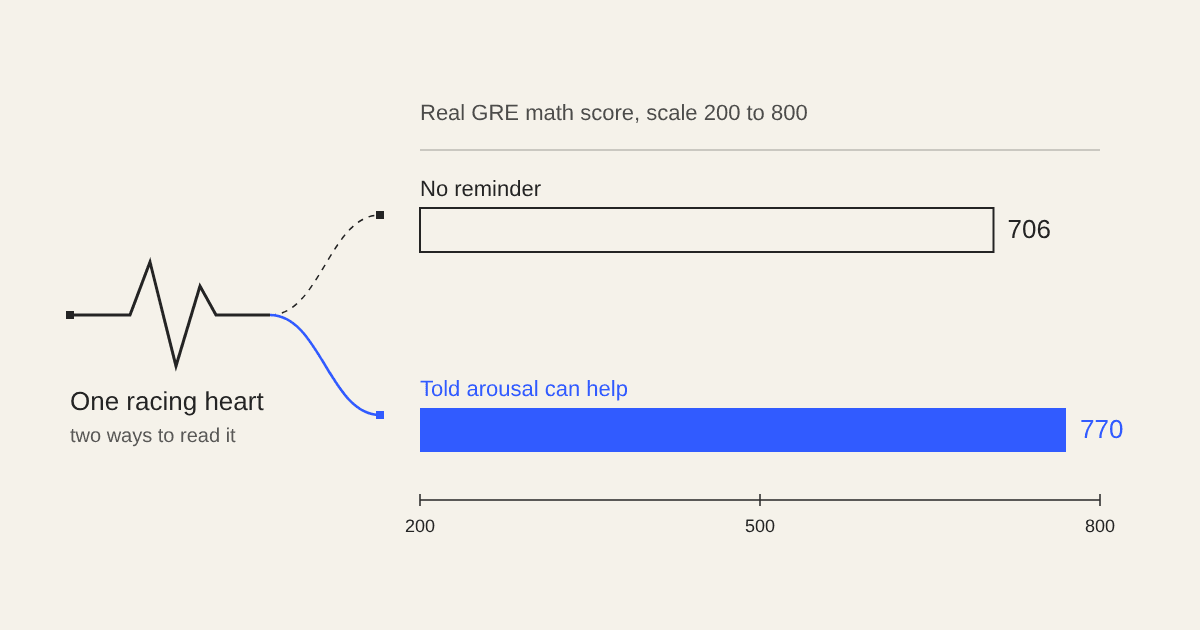
- In a GRE study, test takers told that arousal can help scored higher on the math section than a control group, both in a practice session (about 739 vs 684) and on the real exam (about 770 vs 706).
- The study was small and the effect showed up on math only, so treat it as a promising signal with no guarantee attached.
- Try three moves: name the sensation as energy, decide the one question you most want to answer well, and rehearse the hardest moment before you walk in.
The director across the table asks about your burn rate. Your pulse jumps. Your mouth goes dry. A quiet voice in your head says, here it comes, you are losing the room.
You have the numbers. You know the plan. And for a few seconds, your body acts like you do not.
The meaning you give the signal
Most people try to fix that moment by calming the body down. Slow your breathing, relax your shoulders, make the feeling go away. It rarely works fast enough, and then you have two problems: the pressure in the room and the fact that you cannot get rid of the feeling.
There is another move. Change what the feeling means.
What a GRE study found
Jeremy Jamieson and colleagues worked with students preparing for the GRE. Everyone came in for a practice test and was told the study was about how arousal during a test relates to performance. One group heard a little more. They were told that arousal does not hurt performance on tests like this and can even help it, and they were asked to remind themselves that their arousal could be helping them do well.
The group that got the reminder showed a bigger rise in a stress-related marker in their saliva, so their bodies were more activated. And they did better on the math section: an average of about 739 on the practice test against about 684 for the control group. Months later, when the students sent in their real GRE scores, the reminder group still led on math, about 770 to 706.
Two honest limits. Sixty students were recruited, and only 28 took the real exam in the time window and came back, so the numbers are small. And the effect showed up on math only, with no difference on verbal. Read it as a strong hint about how your body and your interpretation work together. It is no guarantee for your next meeting.
What it does suggest is that the pounding heart can be energy you put to work. The question is what you do with it.
Three things to try
1. Name the sensation as energy. In the car or the elevator, notice what your body is doing. Fast pulse, tight chest, sharp attention. Then say to yourself: this is my body getting ready to perform. Say it plainly. Skip the effort to feel calm and give the feeling a job.
2. Pick the one question you most want to answer well. Before you walk in, decide which question from the room would be the best one to get. Maybe it is the runway slide, or the hire you are defending. Know your first sentence for it. Energy needs a direction, and a clear first sentence gives it one.
3. Rehearse the hardest moment before it happens. Spend two minutes picturing the toughest exchange. See the person who pushes back. Feel your pulse jump. Then watch yourself answer at your normal pace, steady and direct. When the real moment arrives, it will not be the first time your body has been there.
The signal in your chest was always going to show up. You get to decide what it says.

Research referenced
Frequently asked questions
Is it bad to feel nervous before a board or investor meeting?
Feeling aroused before a high-stakes meeting is normal. In one study of GRE test takers, people who were told that arousal can help performance showed a bigger rise in a stress-related biomarker and scored higher on the math section than a control group. How you read the sensation appears to matter as much as the sensation itself.
What does it mean to reappraise arousal?
It means reading the physical signs of stress, such as a fast heartbeat, as your body preparing to perform instead of as a sign that you are failing. In the GRE study, participants were reminded that their arousal could be helping them do well.
Does telling yourself you are calm work better?
The GRE study did not test that comparison. Its control group received no reappraisal message, so the findings cannot tell you whether calming down is better or worse than reading your energy as useful.