How to Stay Mentally Sharp While Recovering From an Injury
Share this post
How mentally fit are you? Find out in seven minutes.
Take the free quizKey points
- Part of the strength you lose when a limb is immobilized comes from the brain sending a weaker signal, not only from shrinking muscle.
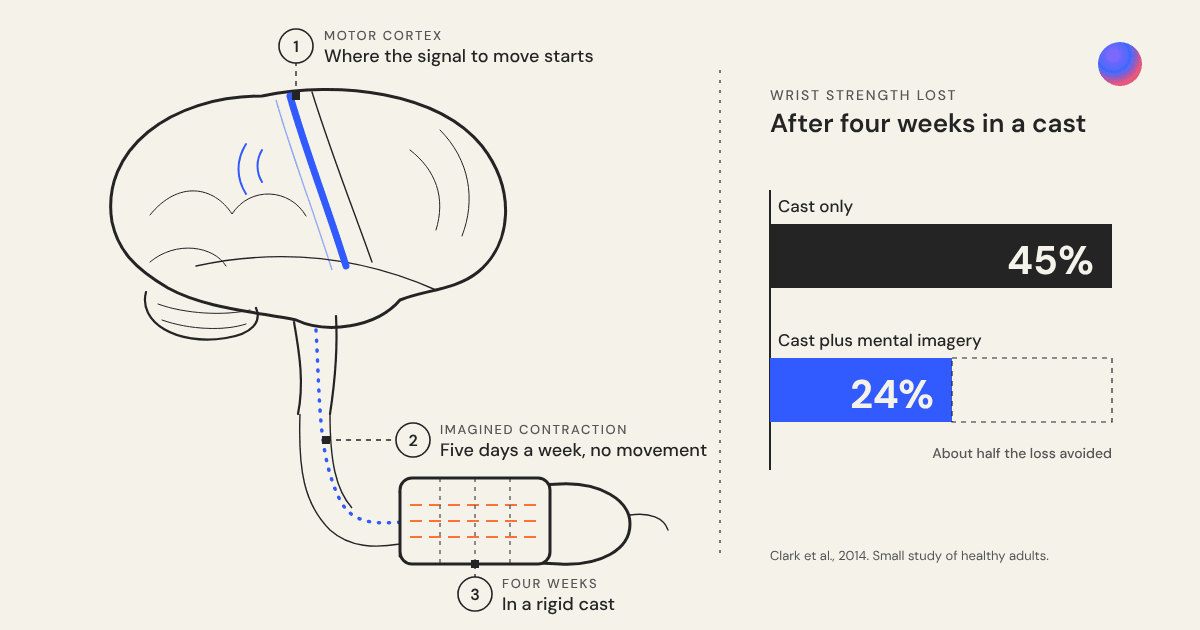
- In a four-week cast study, people who imagined strong contractions five days a week lost about 24 percent of their wrist strength, against 45 percent for people who did nothing.
- The study was small and used healthy adults, so treat imagery as a supplement to your rehab plan.
- Rehearse the movement, the full game-day moment, and the version of you who comes back.
Week three in the boot. You have done the exercises your physio gave you. You have watched the film. And somewhere in the middle of the afternoon you notice that you feel slower, even in your head.
The injury has your body on a clock. It is easy to forget that your mind has one too.
What fades when you stop
When a limb is out of action, the muscle shrinks. Everyone expects that. What gets talked about less is the signal. Strength depends on how hard your brain can drive the muscle, and that drive is something your brain practices every time you move.
Stop moving, and the practice stops with it.
The cast study
Brian Clark and colleagues put the wrist of healthy adults in a rigid cast for four weeks. One group did nothing else. Another group did something odd: five days a week, they sat down and imagined their casted wrist flexing as hard as possible. Fifty-two imagined contractions per session, five seconds of effort, five seconds of rest. Researchers monitored muscle activity to check that nothing actually moved.
After four weeks, the cast-only group had lost about 45 percent of their wrist strength. The imagery group lost about 24 percent. The researchers also measured how fully people could activate the muscle, and that dropped about 23 percent in the cast-only group and about 13 percent in the imagery group.
Two honest limits. The study was small, with 14 or 15 people per group. And participants were not randomly assigned. The researchers chose who did the imagery based partly on who was likely to stick with it. Read it as an early signal that is worth acting on. It also used wrist strength in healthy people, not a torn ligament in a competitor. Your physio still runs the plan.
What it does tell you is that your head is part of the recovery. The signal you send is something you can keep training.
Three things to try
1. Rehearse the movement itself. Pick one action you will need when you return: the cut, the serve, the first stride off the line. Close your eyes and imagine doing it with full effort. Feel the push through the ground and the muscles you would use. Ten minutes or so, most days, with rests in between like a real set.
2. Rehearse the whole moment, not just the move. Put yourself in the stadium or on the course. Hear the sounds, see your teammates, notice the first contact or the first touch. Your skills live inside a setting. Keep the setting familiar so it does not feel foreign when you are back in it.
3. Spend two minutes with the version of you who has returned. Imagine the first practice back. How you walk in. What your body feels like. What you are thinking about. This is the person you are heading toward, and the more clearly you can see them, the less the long middle weeks feel like waiting.
You cannot train the limb right now. You can train the signal that will drive it.

Research referenced
Frequently asked questions
Can mental imagery slow muscle loss during injury?
One study found that healthy adults in a wrist cast for four weeks who imagined strong contractions five days a week lost about 24 percent of their strength, compared with 45 percent in a group that only wore the cast. The study was small and the groups were not randomly assigned, so it points to a promising direction and does not replace your rehab plan.
How long should I practice mental rehearsal each day?
Each session in the cast study had 52 imagined contractions, five seconds on and five seconds off, which came to roughly 12 minutes with short breaks. Short, focused sessions done consistently are a reasonable place to start. Check with your physio about anything that involves the injured area.
Is it safe to imagine movement with an injured limb?
Imagining a movement does not load the tissue. In the study, researchers monitored muscle activity to confirm participants were imagining the contraction without actually performing it. Follow your medical team’s guidance on what you can physically do.