How to Train Your Mind With the Same Consistency You Bring to Your Workouts
Share this post
How mentally fit are you? Find out in seven minutes.
Take the free quizKey points
- Your mind responds to repeated practice the way a muscle does. In one study, 12 weeks of imagined finger contractions raised finger strength by 35%, with no physical training at all.
- Consistency comes from a fixed cue, a short session and a simple log. In a study of daily habits, it took a median of 66 days for a new behavior to feel automatic, with a range of 18 to 254 days.
- A missed day does not undo the work. The same study found that missing one opportunity did not materially affect how the habit formed.
You know exactly what you lifted last Tuesday. You know your easy pace, your rest days and how many weeks until the next race. Now try to answer this: when did you last train your mind on purpose?
For most people the honest answer is never, or only when something went wrong. A bad week, a big day coming up, a night of lying awake. The mind gets attention the way an injury does. You only think about it when it hurts.
The part of you that never gets a program
The body gets a plan. Sets, reps, progression, a log. The mind gets hope. You hope you feel focused at work. You hope you stay calm in the hard conversation. You hope the motivation shows up on the cold morning.
You would never expect your squat to improve by hoping. Yet that is how most of us treat the thing that decides how we show up for everything else, including the squat.
Mental reps are real reps
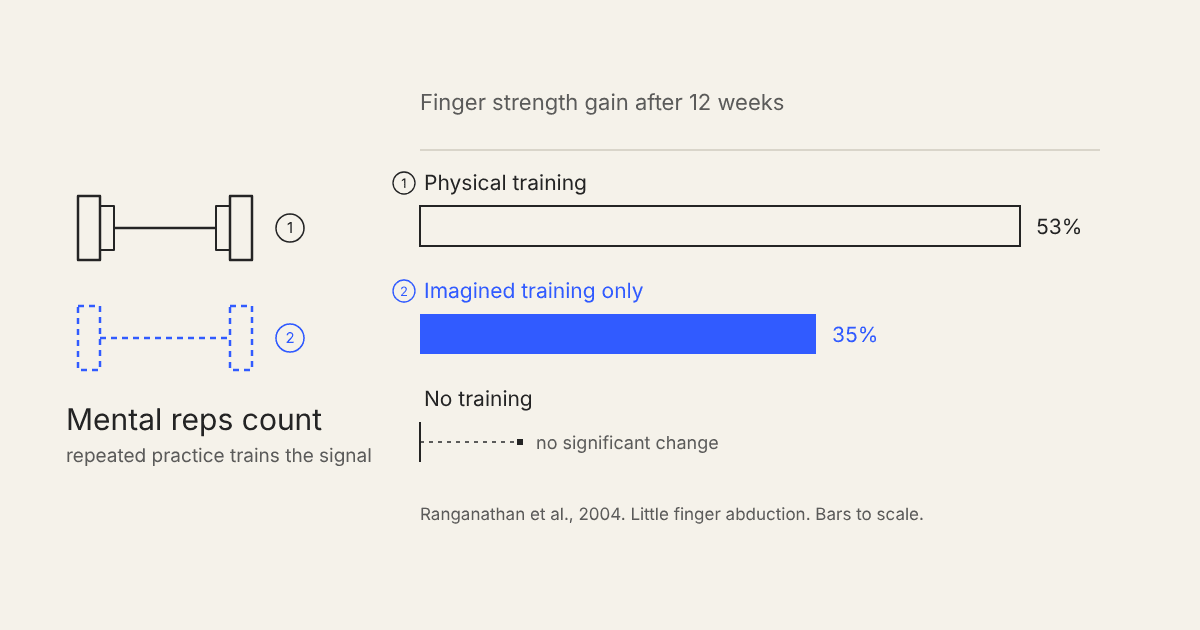
Here is the surprising part. Your brain responds to imagined practice in ways you can measure. In a study led by Vinoth Ranganathan, young adults spent 12 weeks imagining hard contractions of their little finger. Five sessions a week, 15 minutes each, with almost no muscle activity. Their finger strength went up by 35%. A group that trained the same muscle physically gained 53%. A control group that did nothing showed no significant change.
The researchers traced the gain to the brain. Imagined training strengthened the signal the brain sends to the muscle, so the muscle was driven harder when it was finally used. It was one small muscle in a small group, so read it as a clue. The clue is that repetition shapes the mind, and the mind shapes what the body does.
If mental reps count, the next question is how to keep doing them. In a study from University College London, 96 people picked one healthy behavior, such as a short run before dinner or a glass of water with lunch, and did it daily in the same context for 12 weeks. It took a median of 66 days for the behavior to feel automatic, with a range of 18 to 254 days. And missing a single day did not materially affect the process.
That is how training works in the gym too. It is the steady return that builds it.
Three things to try
1. Attach two minutes to a cue you already hit every day. The car park before the gym. Lacing your shoes. The first minute of your cooldown. Same place, same moment, every time. In those two minutes, close your eyes and rehearse one moment from your day ahead as the version of you who handles it well. See the room, hear the voices, feel how you stand. Generic statements like "I am confident" give your mind nothing to practice. A specific, vivid scene does.
2. Log it like a set. You track miles and weight because what gets tracked gets trained. Do the same here. Write the date, the moment you rehearsed and a score from 1 to 10 for how sharp you felt after. After a few weeks you will see a pattern you would never notice from memory.
3. Treat a missed day like a missed workout. One skipped session does not cost you the season. Do the next one. The mistake is letting one miss become a week, then calling the whole thing off. If you need a picture of what a rehearsal session can look like, start with why a big presentation gets easier the second time.
You already know how to train. You show up, you do the reps, you come back tomorrow. Give your mind the same deal.

Research referenced
- Ranganathan, V. K., Siemionow, V., Liu, J. Z., Sahgal, V., & Yue, G. H. (2004). From mental power to muscle power: Gaining strength by using the mind. Neuropsychologia, 42, 944-956.
- Lally, P., van Jaarsveld, C. H. M., Potts, H. W. W., & Wardle, J. (2010). How are habits formed: Modelling habit formation in the real world. European Journal of Social Psychology, 40, 998-1009.
Frequently asked questions
Can you get stronger just by imagining exercise?
In a 2004 study, young adults who imagined maximal contractions of their little finger for 15 minutes, five days a week for 12 weeks, increased finger strength by 35%. A group that trained the same muscle physically gained 53%, and a control group showed no significant change. The researchers linked the gain to a stronger signal from the brain to the muscle.
How long does it take for a new habit to become automatic?
In a 2010 study where people repeated a daily eating, drinking or exercise behavior in the same context, the median time for it to feel automatic was 66 days. The range was wide, from 18 to 254 days, so the popular figure of 21 days does not come from this research.
Does missing a day ruin a new habit?
The same 2010 study found that missing one opportunity to perform the behavior did not materially affect the habit formation process. What matters more is returning to the routine the next day.