How to Handle Pre-Game Nerves and Turn Them Into Focus
Share this post
How mentally fit are you? Find out in seven minutes.
Take the free quizKey points
- Anxiety and excitement both come with a fast heart and a charged body, so it is often easier to relabel the energy than to switch it off.
- In experiments by Alison Wood Brooks, people who said "I am excited" before singing karaoke scored about 80 percent on the game rating, against about 53 percent for people who said "I am anxious".
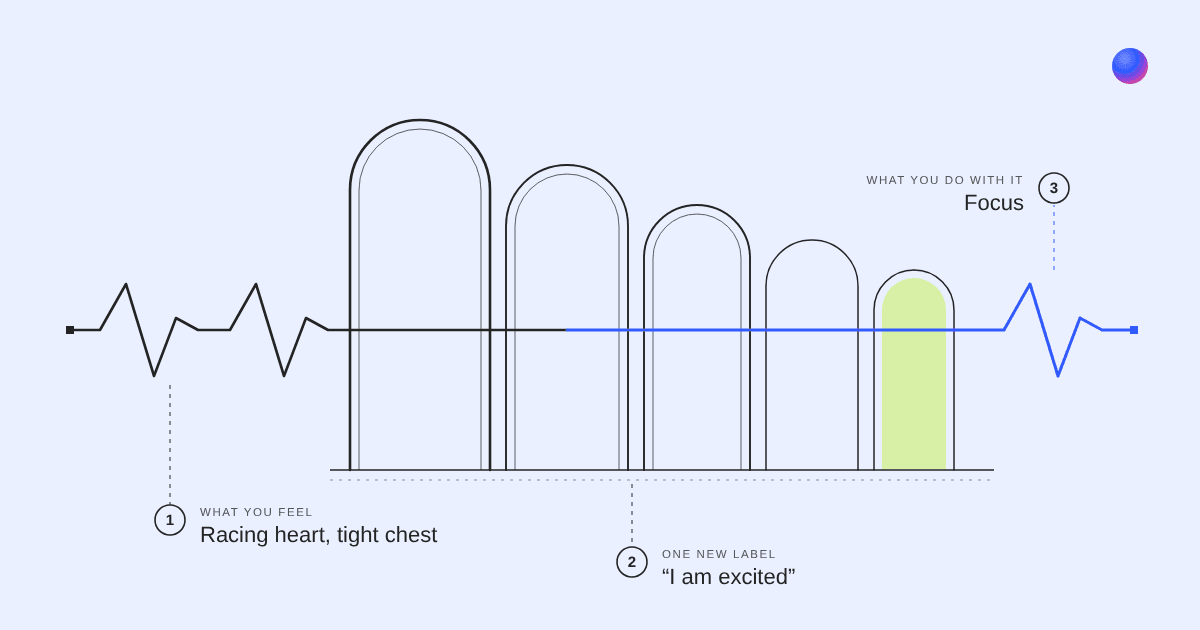
- Try saying "I am excited" out loud, naming what each sensation is doing for you, and rehearsing the walk-out in detail before game day.
You are standing in the tunnel. Your heart is going fast, your hands feel buzzy, and a small voice says you should calm down. You try. You breathe slowly and tell yourself to relax. The buzzing gets louder.
That is a common experience, and there may be a reason. Calming down asks your body to drop from high energy to low energy right when the whistle is about to go.
Same body, different label
Anxiety and excitement feel a lot alike in the body. Fast heart, charged muscles, sharp attention. What differs is the story attached. One says something is about to go wrong. The other says something is about to happen.
In a series of experiments, Harvard researcher Alison Wood Brooks asked people to say how they felt before a stressful task. Before singing a rock song on a video game console, some said they were anxious, some said they were excited, and others said calm, angry or sad. The game rated pitch, rhythm and volume. The excited group averaged about 80 percent. The calm, angry and sad groups averaged about 69 percent. The anxious group averaged about 53 percent.
In another experiment, people who tried to get excited before a hard math test scored about 8 percent higher than people who tried to stay calm and people who got no instruction. In a third, people who said "I am excited" before giving a speech were judged more persuasive and more competent than people who said "I am calm".
Keep the limits in view. The participants were college students and members of the local community doing short tasks. They were not competing athletes in a stadium.
In a study from the University of Exeter, people were randomly assigned to an intervention that encouraged them to see their arousal as helpful, or to a control group, before a pressurized dart-throwing task. The reappraisal group showed more favorable cardiovascular responses and reported more self-confidence. The researchers did not detect a difference in dart performance. So this is a way to feel and respond better under pressure. It is not a guaranteed score boost.
Three things to try
1. Say it out loud. In the warm-up or the tunnel, say "I am excited." Say it like you mean it, even if part of you does not buy it yet. It is a short move you can do anywhere, and it is the one the karaoke experiment tested.
2. Give each sensation a job. Heart racing: my body is sending blood to my legs. Buzzing hands: I am switched on. Tight chest: I am ready for the first contact. The feeling stays, and you read it as preparation. If you have read how the same idea works in a tough board meeting, this is the same move in a different arena.
3. Rehearse the walk-out ahead of time. The night before, take two minutes and run the first minute of the game in your head. The sound of the crowd, the feel of the surface under your feet, the first touch. See yourself with a fast heart and playing well anyway. It works for the same reason a big presentation gets easier the second time: when the moment arrives, your body has already been there once.
The nerves were never the problem. They are energy with no direction yet. Give them one, and they start to look a lot like focus.

Research referenced
- Brooks, A. W. Get excited: Reappraising pre-performance anxiety as excitement. Journal of Experimental Psychology: General. Published online December 2013. Summarized in the American Psychological Association press release, "Getting excited helps with performance anxiety more than trying to calm down, study finds."
- Sammy, N., Anstiss, P. A., Moore, L. J., Freeman, P., Wilson, M. R., & Vine, S. J. (2017). The effects of arousal reappraisal on stress responses, performance and attention. Anxiety, Stress & Coping.
Frequently asked questions
Is it better to calm down or get excited before a competition?
In a series of experiments, people who told themselves they were excited before a stressful task did better than people who tried to calm down. In the karaoke experiment, the excited group averaged about 80 percent on the game rating, the calm group about 69 percent, and the anxious group about 53 percent. These were college students and community members doing short tasks, not professional athletes, so treat it as a strong lead to test in your own warm-up.
Does telling yourself "I am excited" improve performance?
It did in the experiments by Alison Wood Brooks, including a difficult math test where the excited group scored about 8 percent higher than the calm and control groups. A separate study on dart throwing under pressure found that a reappraisal intervention improved confidence and stress responses but did not detect a change in dart performance. The effect is real in some settings and not guaranteed in all of them.
What does it mean to reappraise nerves as excitement?
It means keeping the physical energy and changing the meaning you give it. Your heart is racing either way. Instead of reading it as a sign something will go wrong, you read it as your body getting ready to perform.